Scalp ampoules and tonics are having a breakout moment in global e-commerce. On Amazon US, hair-regrowth-tonic listings saw review volumes climb 3.8x year-over-year in 2025; on Qoo10 Japan, scalp-essence reviews grew more than 5x over the same period — and Korean brands now hold all of Qoo10 JP's top 10 spots in the category, plus three of Amazon US's. The driver behind the surge has a name: Hair Longevity. Instead of marketing hair-loss treatments, K-beauty brands are reframing the category as preventive anti-aging for the scalp — skincare logic applied above the hairline, before visible thinning ever starts.
The ingredient data backs up the positioning shift. In Q3 2025, exosomes were the fastest-growing scalp-care ingredient on Qoo10 JP (+57.9%), with PDRN close behind (+13.3%); on Amazon US, peptide complexes surged +550% and exosomes grew +71.4%. These are, almost without exception, actives borrowed directly from medical-grade regenerative skincare — K-beauty is simply first to move them onto the scalp, ahead of where the rest of the market is looking.
Most of these actives, however, are built to do one job: signal repair to the follicle. They say little about the scalp environment the follicle actually sits in — the sebum buildup and dead-skin accumulation that, left unaddressed, keep undermining hair health regardless of how much regenerative signaling you add on top.
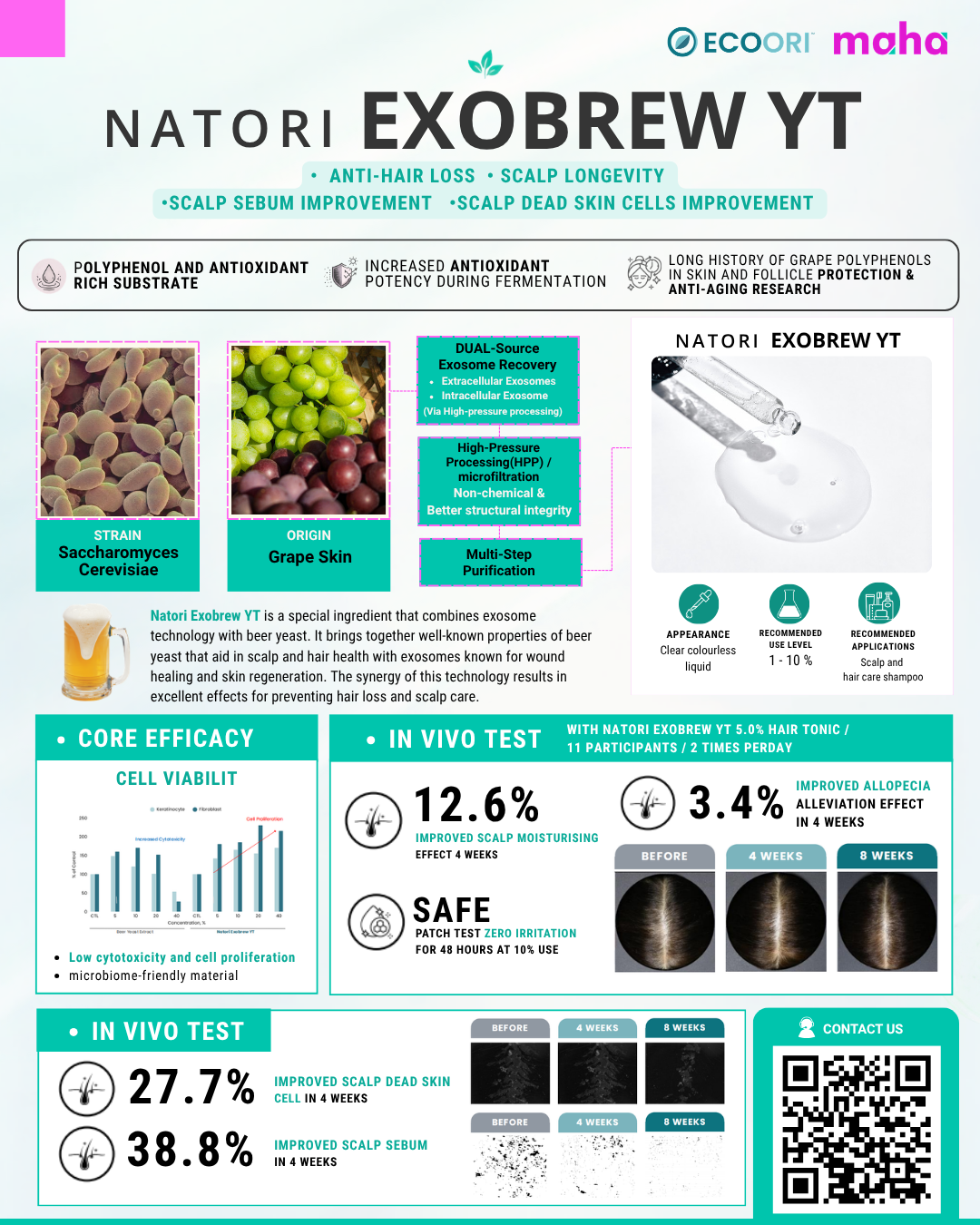
Natori Exobrew YT™, a fermentation-derived active from Korean biotech supplier ECOORI, is built to work on both fronts at once. It pairs a dual-source exosome complex — extracellular exosomes, plus intracellular exosomes recovered via high-pressure processing (HPP) and microfiltration — with a beer-yeast (Saccharomyces Cerevisiae) fermentate grown on a grape-skin substrate, chosen for its polyphenol and antioxidant content. The result is a clear, colourless liquid recommended at 1-10% for scalp and hair care shampoo and scrub formats (the efficacy data below used a 5.0% hair tonic format).
Mechanism
The exosome fraction is recovered through a dual-source process: extracellular exosomes, plus intracellular exosomes released via high-pressure processing and microfiltration — a non-chemical method the supplier notes preserves better structural integrity than solvent-based extraction. Fermenting Saccharomyces Cerevisiae on a grape-skin substrate adds a second layer: antioxidant potency increases over the course of fermentation, building on the long-documented role of grape polyphenols in skin and follicle protection. Combined, the two mechanisms target the follicle itself (via exosome signaling) and the surrounding scalp surface (via fermentation-derived antioxidants) at the same time.
Clinical Data
In an in vivo test using a 5.0% Natori Exobrew YT hair tonic (11 participants, applied twice daily), the supplier recorded a 3.4% improvement in alopecia alleviation and a 12.6% improvement in scalp moisturising after 4 weeks, alongside a 27.7% improvement in scalp dead skin cell condition and a 38.8% improvement in scalp sebum after 4 weeks. Separate cell-based testing showed low cytotoxicity alongside active cell proliferation, and a 48-hour patch test at 10% use recorded zero irritation.
Why It Matters for Formulators
The Hair Longevity trend is pulling scalp care toward the same standard skincare is already held to: multiple, specific, measurable claims, rather than one broad promise. Natori Exobrew YT™ gives formulators four distinct data points to build around — hair loss alleviation, moisturising, dead skin cell improvement, and sebum control — from a single microbiome-friendly, fermentation-derived active, at a use level flexible enough for shampoo or scrub formats.
Interested in samples or the full technical data sheet? Reach out to the MAHA team below.