Di edisi sebelumnya, kami membahas tentang menemukan “NVIDIA berikutnya” — bahan aktif upcycled yang undervalued tetapi memiliki potensi besar, sementara pasar terlalu fokus pada nama-nama yang sudah terkenal. Namun sebelum mengubah seluruh portofolio, mari kita lihat apa yang sudah ada.
Tidak semua bahan yang populer itu overhyped, beberapa memang sudah terbukti kualitasnya. Pertanyaannya bukan apakah harus dimasukkan, tapi apakah Anda menggunakannya dengan benar dan di waktu yang tepat.
Edisi kali ini: tiga bahan aktif yang wajib ada di formulasi Anda, masing-masing dengan alasan mengapa 2026 adalah waktu yang tepat untuk menggunakannya.
Mengapa Sekarang?
Pasar bahan aktif sangat ramai. Setiap musim muncul varian exosome baru, bahan aktif regenerasi baru, klaim umur panjang baru yang "terinspirasi oleh NAD+". Suara dan “noise” di pasar sangat tinggi.
Di tengah kondisi ini, bahan aktif yang memiliki bukti ilmiah kuat — melalui publikasi peer-reviewed, data klinis berkualitas tinggi, atau mekanisme yang jelas — akan menonjol. Berikut shortlist-nya:
1. Natori Exobiome LB — Update Jurnal Global 2026
Exobiome LB telah hadir sebagai postbiotic aktif: vesikel ekstraseluler (EVs) yang berasal dari Lactobacillus, dengan ukuran partikel rata-rata 100,5 nm — sekitar 300× lebih kecil dari pori kulit. Teknologi hebat dan biologis konsisten, tapi tanpa validasi akademik independen, mudah dianggap sekadar “postbiotic biasa”.
Itu berubah di 2026.
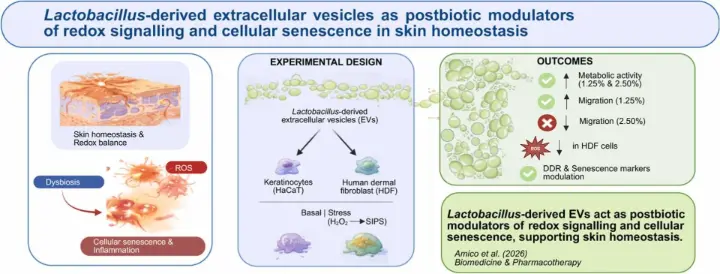
Natori Exobiome LB dipublikasikan di Biomedicine & Pharmacotherapy (Vol. 199, Article 119457 — Open Access CC BY 4.0). Penelitian dilakukan oleh Universitas Medis Gdansk (Polandia) dan Universitas Palermo (Italia), independen dari supplier. Ini adalah publikasi peer-reviewed pertama yang mengindeks bahan ini.
Hasil (in vitro: HaCaT keratinosit + HDF fibroblas):
- Aktivitas metabolik: peningkatan signifikan secara statistik pada 1,25–2,5% v/v (p<0,05)
- Penutupan luka: ~4 jam lebih cepat dibanding kontrol pada 1,25% v/v (p<0,0001)
- Stres oksidatif: pengurangan ROS intrasel signifikan pada fibroblas di 1% v/v (p<0,05)
- Anti-penuaan sel: downregulation marker p21 dan 53BP1 pada keratinosit (p<0,01)
Catatan formulasi: Semua hasil dari in vitro. Penelitian menyebutkan penetrasi stratum corneum tidak diuji. Tingkat sains in vitro yang ketat — bukan bukti klinis. Tambahkan di fase air <60°C. Penggunaan direkomendasikan: 1,0–5,0%.
Bagi formulators yang menahan diri menunggu validasi ilmiah independen untuk postbiotic EV, benchmark ini kini sudah jelas.
2. Natori PDRN — Standar dengan Alasan Tepat
Beberapa bahan tetap berada di puncak karena belum ada yang menggantikannya. PDRN (polydeoxyribonucleotide) adalah salah satunya.
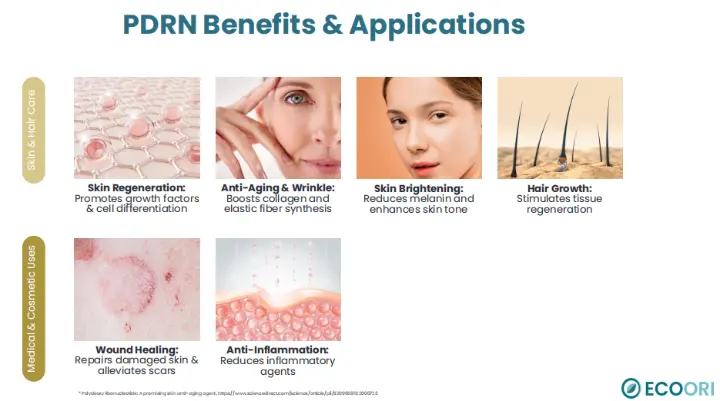
Natori PDRN 95 (Sodium DNA, kemurnian 95%+, berasal dari salmon budidaya) masih menjadi salah satu bahan aktif regenerasi dengan data paling lengkap yang tersedia — terutama pada tingkat kemurnian yang membedakannya dari sebagian besar sumber pesaing (biasanya 85–90%).
Data klinis:
- Wound healing: 96% penutupan luka pada 0,1% / 24 jam
- Barrier: ekspresi FLG mRNA +287%
- Moisturization: ekspresi AQP3 mRNA +227% setelah UVB
- Anti-inflamasi: pengurangan NO ×3,6 pada 10%
- Brightening: inhibisi tirosinase (dikonfirmasi DPPH antioxidant assay)
- Safety: uji patch 33 orang, Korea Institute of Dermatological Sciences — non-irritating
Perbedaan tingkat kemurnian memiliki implikasi formulasi yang melampaui sekadar teks pemasaran. Kemurnian yang lebih tinggi berarti bau tidak sedap yang lebih rendah dan profil sensorik yang lebih bersih — sebuah keunggulan pemrosesan di dunia nyata.
Penggunaan direkomendasikan: 0,1–10% (1.000 ppm = 0,1% PDRN 95 / 1,0% PDRN 10L).
Jika PDRN belum masuk brief regenerasi Anda, ini adalah titik awal. Jika sudah — ini lembar referensi Anda.
3. WRINKLEZERO — Longevity Seluler, Tanpa Masalah Stabilitas
Kategori skincare longevity berkembang pesat — begitu pula dengan banyaknya klaim yang terkait dengan NAD+. Konsepnya bagus: pemulihan energi sel, kesehatan mitokondria, menangani penuaan intrinsik secara metabolik. Tapi, eksekusinya sulit: NAD+ dan derivatifnya terkenal tidak stabil dalam formulasi.
Panas, pH, dan oksidasi bisa merusak aktivitas sebelum sampai ke konsumen. Mendapatkan pengiriman NAD+ yang signifikan ke dalam formula akhir yang stabil merupakan tantangan teknis nyata yang belum sepenuhnya dipecahkan oleh industri.
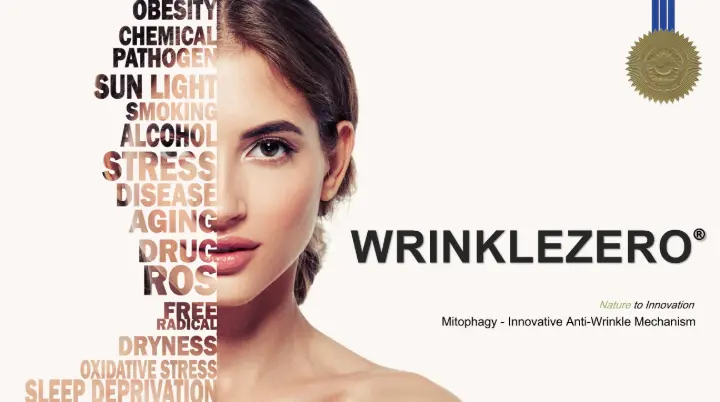
WRINKLEZERO (Ekstrak Buah Vaccinium Angustifolium, Ekstrak Brassica Oleracea Italica, Ekstrak Daun Cynara Scolymus — blueberry, brokoli, artichoke) mendekati biologi yang sama melalui jalur berbeda: aktivasi mitophagy.
Mitophagy adalah mekanisme pembersihan selektif sel untuk mitokondria yang rusak. Jika berfungsi dengan benar, mitophagy menghilangkan mitokondria yang disfungsional dan memungkinkan mitokondria yang lebih sehat untuk memulihkan produksi ATP dan potensial membran — energi seluler yang hilang seiring berjalannya waktu akibat penurunan biologi kulit. Campuran ekstrak tumbuhan WRINKLEZERO mengaktifkan jalur ini, dengan efek hilir yang telah didokumentasikan, termasuk:
- Inhibisi MMP-1 dan MMP-3: cegah kerusakan kolagen & elastin
- Peningkatan produksi Collagen I
- Pengurangan marker senescence sel
- Pemulihan membran mitokondria & ATP
Dalam studi klinis selama 4 minggu, krim yang mengandung 2% WRINKLEZERO dioleskan dua kali sehari. Penilaian dilakukan pada minggu ke-2 dan ke-4 berdasarkan parameter berikut:
- Anti-wrinkle: perbaikan kedalaman kerutan wajah
- Firming: kekencangan kulit wajah secara keseluruhan
- Lifting: peningkatan posisi sudut bibir
Perbaikan terlihat sejak minggu ke-2 dan terus berlanjut hingga minggu ke-4. Uji tempel iritasi kulit pada 31 orang mengkonfirmasi kinerja yang tidak menyebabkan iritasi selama 24 jam. Pengujian viabilitas sel in vitro pada fibroblas manusia juga mengkonfirmasi profil keamanan bahan tersebut pada tingkat penggunaan yang direkomendasikan.
Dari sudut pandang formulasi: WRINKLEZERO adalah kompleks tumbuhan yang larut dalam air. Ia tidak memiliki ketidakstabilan oksidatif seperti zat aktif penunjang umur sel berbasis nikotinamida. Bagi para perumus yang bekerja di bidang penunjang umur sel dan pernah mengalami masalah stabilitas NAD+, ini adalah alternatif yang secara mekanistik koheren dan stabil dalam formulasi.
Penggunaan direkomendasikan: 2%
Beginilah Penerapannya dalam Praktik
Tiga bahan ini tidak saling bersaing, tapi bekerja di level biologis berbeda:
- Exobiome LB (1.0–2.5%): dukungan mikrobiome, anti-penuaan sel, sinyal perbaikan jaringan
- PDRN (0.1–1.0%): pemulihan barrier, brightening, wound healing, anti-inflamasi
- WRINKLEZERO (2%): aktivasi mitophagy, restorasi energi mitokondria, dukungan matriks kolagen
Bersama-sama, mereka menarget: level mikrobiome, extracellular matrix, dan metabolisme energi intrasel — tanpa duplikasi bahan. Brief full-stack sejati.
Siap Mencoba Sampel?
Datasheet teknis dan sampel untuk Natori Exobiome LB, Natori PDRN, dan WRINKLEZERO tersedia melalui MAHA Asia. Tim teknis kami siap membantu Anda menilai data sebelum memasukkan ke formulasi.