In the manufacturing and construction industries, material resistance to corrosion and extreme weather conditions is essential to ensure product quality and durability. Want to make sure your materials are long-lasting and high quality? Read the full article about Q-FOG testing.
Understanding Q-FOG SSP and CCT
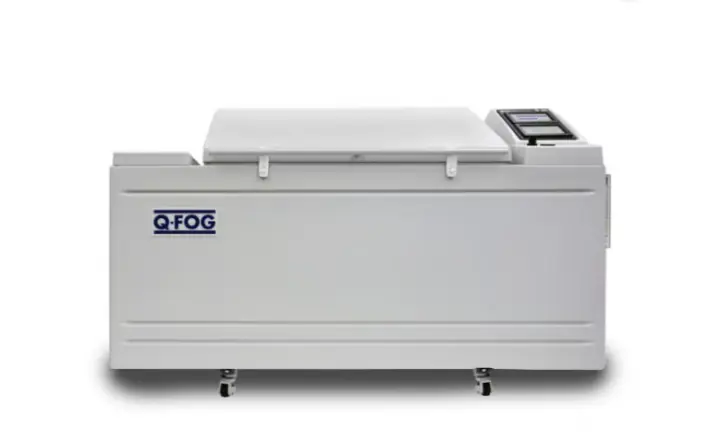
Q-FOG SSP and Q-FOG CCT are two types of weathering test equipment used to evaluate material resistance against corrosion and damaging environmental factors such as humidity and temperature. These instruments utilize fog testing technology to simulate environmental conditions that may affect the long-term durability of materials.
Comparison of Q-FOG SSP and CCT
Q-FOG SSP (Salt Spray / Salt Fog):
Used to test material resistance against corrosion caused by salt fog. This test simulates marine environments or conditions with high salt content, such as coastal areas or industrial zones. Q-FOG SSP provides an overview of how resistant a material is to damage caused by oxidation and corrosion due to exposure to salt water.
Q-FOG CCT (Cyclic Corrosion Testing):
Designed to test material resistance against more complex corrosion cycles. CCT combines humidity cycles, high temperatures, and salt fog in a single test to replicate more dynamic weather changes commonly found in industrial environments or vehicles.
Both instruments are essential for ensuring the quality and durability of materials, especially in the automotive, construction, and manufacturing industries that require strong and long-lasting products capable of withstanding extreme environmental conditions.
The Importance of Corrosion and Salt Spray Testing
Cyclic corrosion testing provides the best laboratory simulation of natural atmospheric corrosion. Research shows that the test results are similar to those obtained outdoors in terms of structure, morphology, and relative corrosion rate produced.
Q-Lab’s Q-FOG SSP model testers can perform traditional salt spray and Prohesion tests. Q-FOG CCT testers can also perform wet/dry cycling with saturated humidity.
Q-FOG chambers are available in two sizes to meet a variety of testing requirements. Q-FOG cyclic corrosion testers are the simplest, most reliable, and easiest-to-use corrosion testers available.
Advantages of Q-FOG SSP and CCT for Industry
Q-FOG SSP (Salt Spray) and Q-FOG CCT (Cyclic Corrosion Testing) offer various advantages that are highly important in material durability testing, especially in the automotive, construction, and manufacturing industries. Below are some of the main advantages of these testing methods:
Fast and Accurate Corrosion Testing
Q-FOG SSP can accelerate the corrosion testing process in extreme environments, providing faster data compared to conventional testing methods that require much more time.
Various Environmental Simulations
This equipment can simulate various corrosion conditions, including salt spray testing, cyclic testing, and humidity testing. This allows industries to evaluate material resistance against different factors that cause corrosion in real-world conditions.
Precision and Consistency
Q-FOG SSP provides precise control over temperature, humidity, and salt concentration during corrosion testing, resulting in consistent and reliable results for long-term analysis.
With these advantages, Q-FOG SSP and CCT are ideal solutions for ensuring that materials used in production can withstand extreme environmental conditions.
Working Mechanism of Q-FOG SSP and CCT
1. Testing Process with Q-FOG SSP
Q-FOG SSP corrosion testers can perform various accelerated corrosion tests, including continuous salt spray (ASTM B117 and ISO 9227) and Prohesion (ASTM G85 Appendix 5). Visit our standards search for more information about Q-FOG SSP capabilities.
Continuous Salt Spray Test exposure is widely specified for testing components and coatings for corrosion resistance. Applications include coatings and paint systems, aerospace and military components, and electrical/electronic systems.
The Prohesion test uses rapid cycling, quick temperature changes, low-humidity drying cycles, and different corrosive solutions to provide more realistic testing conditions.
Most of these tests are performed according to specific standards commonly used for basic corrosion testing. Testing is usually conducted at high temperatures and does not include dry cycles. This requires heated and humidified air for fog delivery.
2. Testing Process with Q-FOG CCT
Q-FOG CCT testers have all the advantages of the SSP model while adding the flexibility to include 100% humidity. Visit our standards search for more information about Q-FOG CCT capabilities.
Automotive corrosion testing methods typically require exposing specimens to repeated cycles of salt spray testing, high humidity, low humidity, dry conditions, and ambient conditions. These testing methods were originally developed as labor-intensive manual procedures. Q-FOG CCT multifunction corrosion testers are designed to perform these cyclic tests automatically within a single chamber. In addition, the CCT model is capable of performing Copper-Accelerated Acetic-Acid Salt Spray (CASS) testing according to ASTM B368 or ISO 9227 CASS standards.
Q-FOG SSP and CCT Supplier in Indonesia
Maha is the official supplier of Q-FOG SSP and CCT in Indonesia. Q-FOG SSP and CCT offer advantages in accelerating the corrosion process on materials such as iron and steel. Contact us at sales@maha.asia for more information!
Need more support?
Let's connect!
We'll get in touch within 1 working day.
HQ Office & Laboratory
51 Tuas West Drive
Singapore 638415
Operating Hours
Monday – Friday | 8:00AM – 5:00PM
Contact
sales@dash-asia.co