Rice is not a new cosmetic ingredient. Women in Japan and Korea have rinsed their skin and hair with rice water for centuries, and in Korea the leftovers of rice wine brewing were used the same way — a folk practice built on the idea that fermented rice invigorates the body, helps recovery from fatigue, and helps the skin regenerate.
What is new is the size of the commercial opportunity behind that heritage.
- The rice-based skincare market was valued at USD 7.2 billion in 2025 and is forecast to reach USD 14.9 billion by 2035, a 7.5% CAGR — growth driven by ingredient-led "clean beauty" buying and by rice moving from a supporting extract to a hero claim on the front of the pack.
- Spate's 2026 Ingredient Trends Report names fermented rice water among the heritage staples gaining traction with consumers in 2026 — alongside high-science actives such as PDRN, beta glucan and peptides. Heritage and biotech are no longer competing categories; they are being bought together.
- Crucially, the growth is no longer only regional. Analysts point to Western consumers adopting traditional Asian rice rituals, amplified by social content, as one of the primary demand drivers — with North America now the single largest market at roughly 32.6% of global value (USD 2.3 billion).
- Clinical evidence is what converts that awareness into repeat purchase. Published work on fermented rice bran has reported skin moisture increases of over 10% and a 25.05% reduction in transepidermal water loss, giving brands something defensible to say beyond nostalgia.
So the brief for 2026 is clear: consumers already trust rice. What they now expect is proof — and a modern reason to believe. That is exactly the gap Natori Exorice SC was built for.
What Natori Exorice SC is
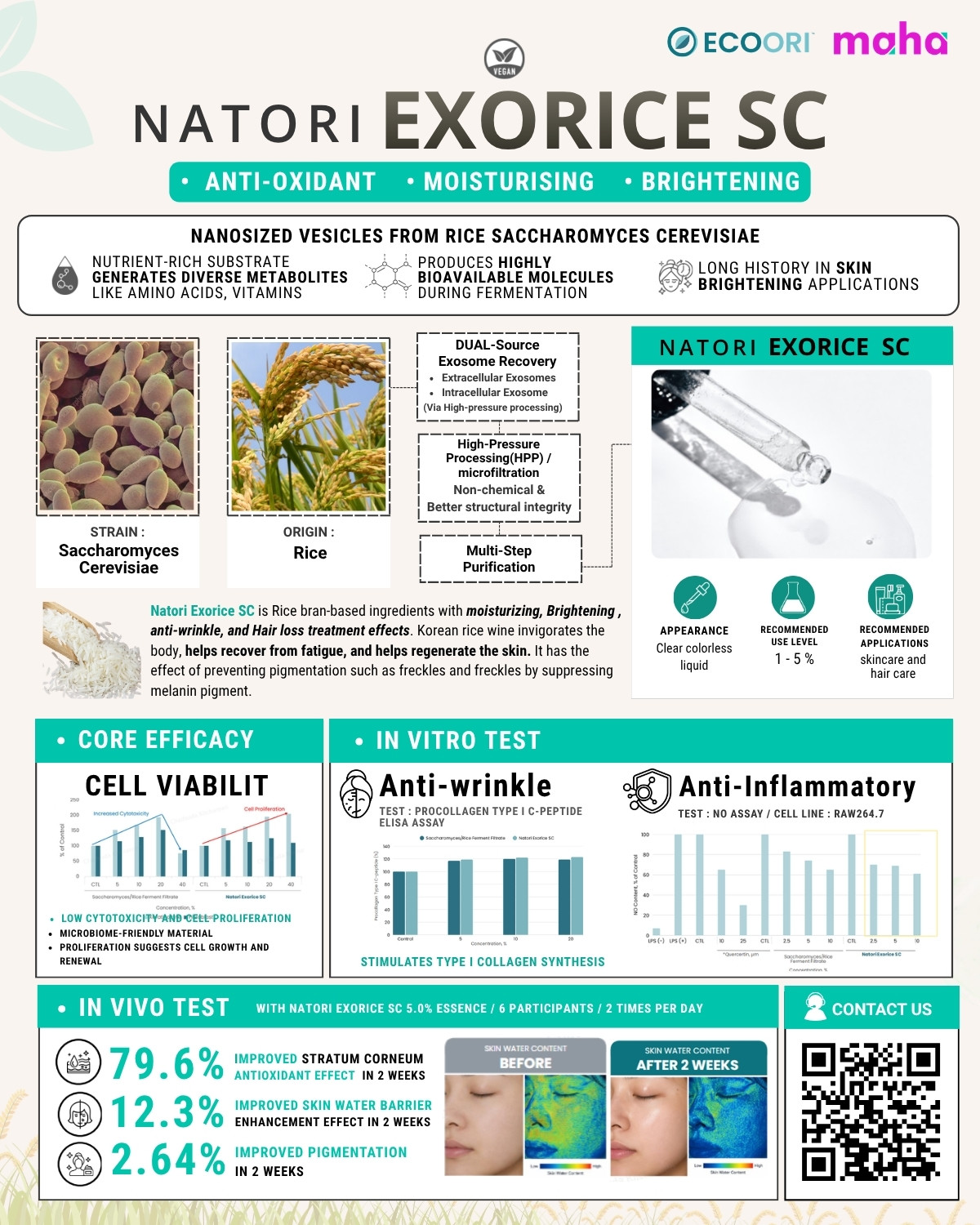
Download the 1-page flyer (JPG)
Natori Exorice SC is a rice bran-based active, fermented with the strain Saccharomyces cerevisiae, and delivered as nanosized vesicles from rice and yeast.
Two things happen during that fermentation:
- The substrate does the work. Rice bran is a nutrient-rich substrate, so fermentation generates a diverse pool of metabolites — amino acids, vitamins — associated with antioxidant, moisturising and brightening performance.
- The molecules become more usable. Fermentation produces highly bioavailable molecules, which is the practical difference between a rice extract that reads well on an INCI list and one that performs in a finished formula.
Layered on top of that is the heritage claim the market already accepts: rice has a long history in skin brightening applications, and Korean rice wine tradition ties it to skin regeneration and to suppressing melanin pigment, helping prevent pigmentation such as freckles and dark spots.
The technology: dual-source vesicle recovery
Most rice ferments capture only what the cells release. Natori Exorice SC captures both sides.
- Extracellular vesicles — recovered from the ferment itself.
- Intracellular vesicles — released via high-pressure processing (HPP).
The route is deliberately non-chemical: HPP plus microfiltration, followed by multi-step purification. The benefit is better structural integrity of the vesicles — the material arrives in the formula intact rather than degraded by solvent or harsh chemical extraction.
For a brand team, this is the "modern reason to believe" that sits on top of a familiar ingredient: a traditional rice story, recovered with a process the technical audience can interrogate.
The data
In vivo — Natori Exorice SC 5.0% essence / 6 participants / applied 2 times per day
| 12.3% | Improved skin water barrier enhancement effect in 2 weeks |
| 2.64% | Improved pigmentation in 2 weeks |
| 79.6% | Improved stratum corneum antioxidant effect in 2 weeks |
Two weeks, one panel, and the two claims that sell in Southeast Asia sitting side by side: hydration and tone. The antioxidant result underneath them is what ties the story together — oxidative stress is a driver of both barrier decline and uneven pigmentation, so a single ferment supports the moisturising and brightening positioning without stacking three separate actives into the formula.
In vitro
| Test | Method | Result |
|---|---|---|
| Cell viability | — | Low cytotoxicity and cell proliferation; microbiome-friendly material. Proliferation suggests cell growth and renewal. |
| Anti-wrinkle | Procollagen Type I C-peptide ELISA assay | Stimulates Type I collagen synthesis |
| Anti-inflammatory | NO assay / RAW264.7 cell line | Anti-inflammatory activity confirmed |
The low-cytotoxicity, microbiome-friendly profile matters more than it sounds: brightening routines are where consumers most often trade results for irritation. An active that supports tone while staying gentle on the barrier is a different conversation with a formulator.
Formulating with it
| Appearance | Clear colorless liquid |
| Recommended use level | 1 – 5% |
| Recommended applications | Skincare and hair care |
| Core efficacy | Anti-oxidant · Moisturising · Brightening |
A clear, colorless liquid at 1–5% is an easy drop-in for essences, serums, toners and ampoules — and because the in vivo panel ran at 5.0% in an essence format, the top of the range is the level with data behind it.
Why now
Rice gives a brand instant consumer recognition — no education budget required. What rice has historically lacked is a technical layer strong enough to justify a premium price and satisfy a formulator.
Natori Exorice SC adds that layer: a defined strain, a dual-source vesicle recovery process, non-chemical extraction, and in vivo data on hydration and tone after two weeks. An ingredient consumers already believe in, with the evidence a 2026 launch needs.
Sources: Rice-Based Skincare Products Market (Market.us, 2026); 2026 Ingredient Trends Report (Spate); product data: Natori Exorice SC technical flyer (Ecoori), 2026.