Reducing the weight of a polymer component can be challenging because using less material may also affect its mechanical performance. Supercritical fluid (SCF) foaming offers another approach by creating a cellular structure inside the polymer, which can reduce density while allowing the material to retain targeted properties.
For thermoplastic polyurethane (TPU), this process has attracted attention because the material already combines elasticity, toughness, and thermoplastic processability. When a physical blowing agent such as carbon dioxide is introduced under controlled conditions, it can dissolve into the polymer and later form microscopic cells as the processing conditions change.
The result is a microcellular TPU structure in which the amount, size, and distribution of the cells become important factors in determining the final performance of the material. Research has shown that processing conditions and TPU molecular structure can significantly influence this cellular structure and, consequently, the mechanical properties of the foam.
What is supercritical fluid foaming?
Supercritical fluid foaming is a physical foaming process that uses a gas, commonly CO₂, as the blowing agent.
When CO₂ is brought above its critical temperature and pressure, it enters a supercritical state, where it has properties that allow it to interact with polymers differently from an ordinary gas. In polymer processing, the supercritical fluid can be introduced into the polymer melt and dissolve within the polymer matrix.
As the processing conditions change, the dissolved gas becomes less soluble in the polymer and begins to form small gas nuclei. These nuclei can then grow into cells, creating the cellular structure that gives the final material its lower density.
The process therefore depends on controlling how the gas enters the polymer, how much gas dissolves into it, and how the cells develop during foaming.
Why does TPU work with this process?
TPU has a segmented molecular structure, and its soft and hard segments contribute differently to the material’s properties. Because of this structure, the behavior of TPU during foaming depends not only on the processing conditions but also on the characteristics of the TPU itself.
For example, research by Nofar, Küçük, and Batı found that hard-segment content affected the foaming behavior of TPU with supercritical CO₂. Changes in hard-segment content influenced crystallization, the processing window, foam expansion, and shrinkage.
More recent research has also shown that molecular structure can influence cell formation. Niu et al. found that branched structures and hard-segment domains could act as heterogeneous nucleation sites, affecting cell density and cell size in microcellular TPU.
This is why SCF TPU cannot be treated as simply a standard TPU with gas added to it. The polymer structure and the foaming process need to work together to produce the desired cellular structure.
How does supercritical TPU foaming work?
The process can be understood through four main stages.
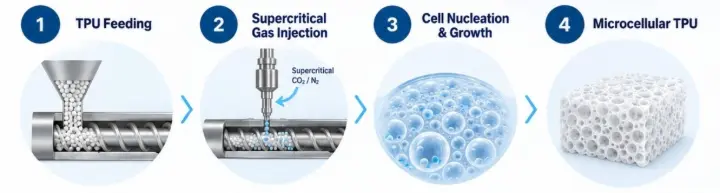
Image 1. TPU Process
1. TPU Feeding
TPU pellets are introduced into the processing equipment and heated until the polymer reaches the appropriate melt condition.
At this stage, temperature control is important because the polymer needs to reach a state where it can accept the supercritical gas while still maintaining sufficient melt strength for subsequent cell formation.
2. Supercritical gas injection
A physical blowing agent, such as CO₂, is introduced into the polymer under controlled pressure.
The gas dissolves into the polymer melt, creating a polymer-gas mixture. How much gas dissolves and how uniformly it distributes depends on factors such as pressure, temperature, saturation time, and the characteristics of the TPU.
3. Cell nucleation and growth
As the pressure and temperature conditions change, the dissolved CO₂ becomes less soluble in the polymer.
This creates the conditions for cell nucleation, after which the nuclei can grow as the gas expands. The way this happens determines the size, density, and distribution of the cells throughout the TPU.
Research on TPU foaming has shown that changing the foaming temperature and CO₂ pressure can produce different cellular structures and mechanical properties.
4. Microcellular TPU
Once the foaming process is completed, the TPU contains a network of microscopic cells that reduces its overall density.
The resulting properties depend heavily on the cellular structure. Cell size, cell density, and how uniformly the cells are distributed can all influence mechanical behavior, including resilience and compression performance.
What happens inside the TPU?
Before foaming, the TPU is a relatively dense polymer matrix. After the supercritical gas has been introduced and the cells have formed, part of the material’s volume is occupied by these microscopic gas-filled spaces.
Because the cells are distributed throughout the polymer, the material can achieve a much lower density without requiring the entire polymer formulation to be changed.
However, reducing density alone does not determine whether the resulting foam will perform well. If the cells become too large, too small, irregular, or poorly distributed, the mechanical properties can change as well.
This relationship between cellular structure and performance is one of the reasons why SCF TPU processing requires careful control.
What controls the foaming process?
Several variables interact during SCF foaming, which is why achieving a consistent result requires more than controlling one processing parameter.
1. Temperature
Temperature affects the viscosity and physical state of the TPU, while also influencing CO₂ solubility and the conditions under which cells form.
2. Pressure
Pressure influences how much CO₂ can dissolve into the polymer. When the pressure changes, the solubility of the gas changes as well, which affects nucleation and cell growth.
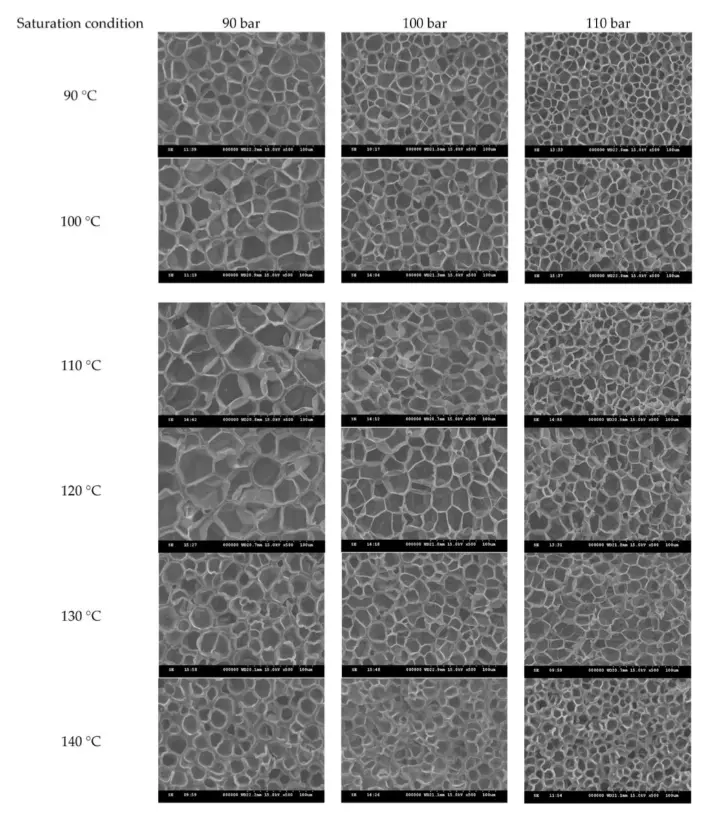
Image 2. Pressure Foamming Process
As the saturation pressure increased, the cell size decreased and the cell density increased. The solubility of CO(2) in the TPU is proportional to the increase of saturation pressure, which contributes to increasing the nucleation sites and resulting in the reduction of cell size and increase of cell density.
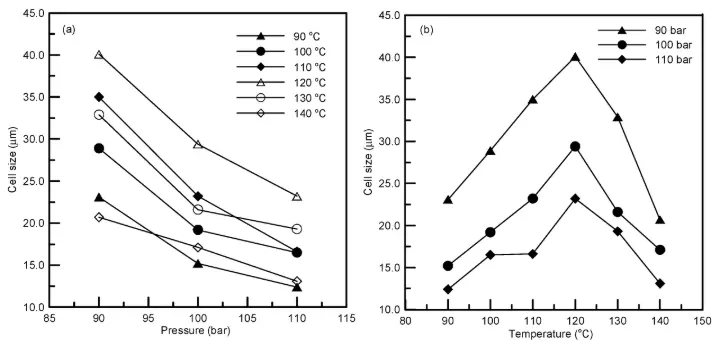
Image 3. Cell size decreased
3. Gas concentration
The amount of dissolved gas influences the potential for cell formation and expansion. However, the final result also depends on how the gas interacts with the specific TPU grade.
4. TPU molecular structure
The TPU itself plays an important role because molecular structure, hard-segment content, crystallinity, and melt behavior can affect nucleation and cell stability.
Because these factors interact, changing one parameter can affect several parts of the foaming process at the same time.
What can microcellular TPU offer?
When the cellular structure is properly controlled, microcellular TPU can combine several useful characteristics.
- Lower density: The cells replace part of the solid polymer volume with gas, reducing the overall density of the material. This can help manufacturers reduce the weight of components.
- Resilience: TPU already has elastic properties. A controlled cellular structure can further influence how the material responds to compression and releases energy. Research has linked foam morphology and processing conditions with the resilience and compressive behavior of TPU foams.
- Lightweight cushioning: The combination of low density and elastic behavior makes microcellular TPU relevant to applications where weight and cushioning need to be considered together.
- Adjustable mechanical performance: Changing the TPU formulation and foaming conditions can produce different cellular structures. That gives manufacturers another variable to work with when designing the final material.
COIM’s SCF TPU Grades
COIM’s SCF TPU portfolio is divided into three performance categories in the supplied material:
Grade | Positioning | Key characteristics
|
Series 01 & 102
| High End
| Strong mechanical properties, heat resistance, density approximately 0.12–0.16 g/cm³, Shore hardness H 35–55C, rebound 75–82%
|
Series 60
| Moderate
| PTMEG-based TPU, strong mechanical properties, density approximately 0.15–0.19 g/cm³, Shore hardness H 35–55C, rebound 65–74%
|
Series 90
| Economic
| Aromatic polyester TPU, excellent mechanical properties, density approximately 0.23–0.26 g/cm³, Shore hardness H 43–55C, rebound 43–55%
|
Looking to reduce weight without compromising the performance of your TPU component?
COIM’s SCF TPU grades are designed for different density, hardness, rebound, and mechanical performance requirements. Our team can help you evaluate the right grade and processing approach for your application.
Explore COIM’s SCF TPU solutions or contact our technical team to discuss your requirements!
References
- Di Maio, E., & Kiran, E. (2018). Foaming of polymers with supercritical fluids and perspectives on the current knowledge gaps and challenges. The Journal of Supercritical Fluids, 134, 157–166.
- Wang, G., Wan, G., Chai, J., Li, B., Zhao, G., Mu, Y., & Park, C. B. (2019). Structure-tunable thermoplastic polyurethane foams fabricated by supercritical carbon dioxide foaming and their compressive mechanical properties. The Journal of Supercritical Fluids, 149, 127–137.
- Nofar, M., Küçük, E. B., & Batı, B. (2019). Effect of hard segment content on the microcellular foaming behavior of TPU using supercritical CO₂. The Journal of Supercritical Fluids, 153, 104590.
- Niu, C., Gao, X., Chen, Y., Sun, W., Zhao, L., & Hu, D. (2025). Supercritical CO₂ foaming and mechanical properties of thermoplastic polyurethane based on molecular structure. The Journal of Supercritical Fluids, 219, 106541.
- Hsiao, Y.-T. et al. (2021), “Preparation of Microcellular Foams by Supercritical Carbon Dioxide: A Case Study of Thermoplastic Polyurethane 70A,” Processes, 9, 1650.