Skincare's biggest positioning shift over the past year hasn't been a new ingredient — it's a new frame. The industry is moving from "anti-aging" (correcting visible signs after the fact) to "longevity" (supporting the skin's own cellular health so damage accumulates more slowly to begin with). Analysts track this as a market moving from roughly $800B toward an estimated $1.9 trillion by 2034 — and increasingly, it's precision-driven: instead of vague longevity claims, new actives are expected to target specific, named biological mechanisms rather than just "inflammation" or "aging" in general.
Autophagy sits near the center of that shift. It's the cell's own recycling system — clearing out damaged proteins, organelles, and debris so healthy function can continue — and the mechanism earned Yoshinori Ohsumi the 2016 Nobel Prize in Physiology or Medicine. When autophagy slows, cellular housekeeping falls behind; it's part of why current longevity-focused actives are being formulated specifically to stimulate it.
Melanophagy is what that same pathway looks like when it's aimed at one specific job: selectively clearing melanosomes, the cell structures that store melanin. It's a precise, mechanism-specific slice of the broader longevity story — peer-reviewed reviews on melanophagy (as recently as this year) frame it exactly that way — applied here to a very different problem than most longevity actives target: hyperpigmentation, still Southeast Asia's number-one skincare concern.
That matters because the conventional brightening approach — inhibiting tyrosinase to slow down new melanin production — leaves an open question. Melanin that's already been made and deposited in the skin doesn't just disappear because synthesis has stopped. It still has to be cleared, and that clearance normally just waits on the skin's own turnover cycle — weeks to months. Melanophagy is a genuinely different lever: not "stop making more," but "clear out what's already there."
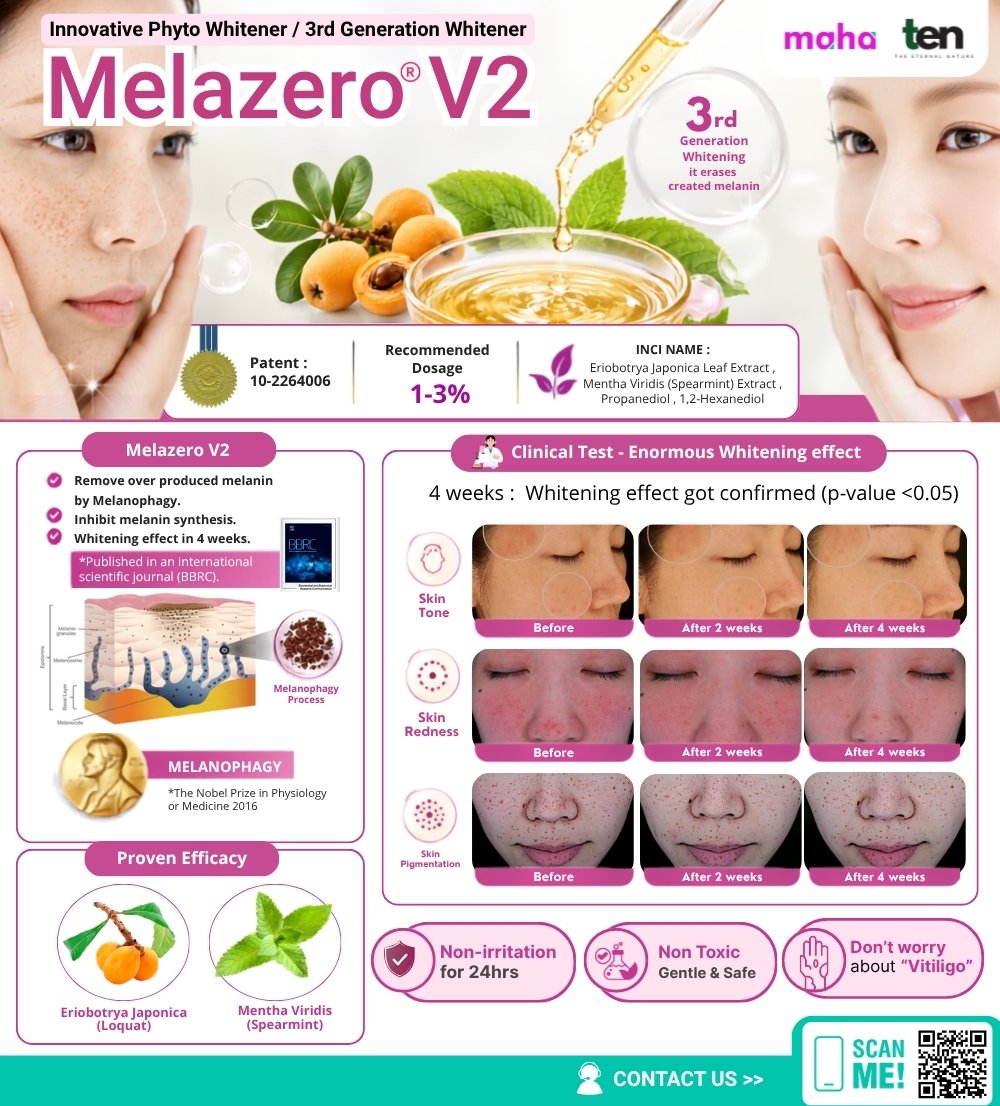
Melazero® V2, supplied by TEN and available through MAHA, is positioned by its manufacturer as a "3rd generation whitening" active built on exactly this dual logic.
The Active: Melazero® V2
Melazero® V2 is a phyto-complex based on two plant extracts — Eriobotrya Japonica (Loquat) Leaf Extract and Mentha Viridis (Spearmint) Extract, formulated in a Propanediol / 1,2-Hexanediol carrier system. It's patented (KR Patent No. 10-2264006) and the supplier's recommended use level is 1–3%.
What makes it worth a formulator's attention is the second mechanism layered on top of standard brightening action.
How It Works: Two Mechanisms in One
Per the supplier's data, Melazero® V2 works in two ways:
- Inhibits melanin synthesis — the conventional brightening mechanism shared with most actives on the market today.
- Clears over-produced melanin via melanophagy — the autophagic degradation pathway described above, targeting melanin/melanosomes that have already formed.
The supplier reports this mechanism was published in an international scientific journal (BBRC — Biochemical and Biophysical Research Communications). This dual-action framing is what the flyer calls "3rd generation whitening": earlier generations focused on synthesis inhibition alone; this one also addresses what's already been produced.
Clinical Data
In the supplier's 4-week clinical test, whitening effect was confirmed with just 1% concentration, tracked across three parameters with before / 2-week / 4-week photography:
- Skin tone
- Skin redness
- Skin pigmentation
Safety data reported alongside the efficacy results: no irritation over 24 hours, and the supplier notes the ingredient is non-toxic. The flyer also specifically addresses a safety question formulators in this category are increasingly asked about — vitiligo/leukoderma risk — stating the ingredient does not raise this concern. (This is supplier-reported safety data from the flyer; formulators should request full study documentation for their own regulatory files.)
Where It Fits
If your current whitening formulation relies solely on synthesis inhibition, Melazero® V2 is worth evaluating as a complementary or replacement active that also addresses melanin already sitting in the skin — a mechanism grounded in genuine (and still-emerging) autophagy science, not just a marketing angle.
Want the Full Data Package?
Reach out for the technical data sheet and clinical summary, or request a free sample.