Hydroquinone's regulatory status is a patchwork, not a uniform trend. It's prohibited in leave-on cosmetics in Korea and China, and allowed under concentration limits across most of Southeast Asia and Europe. That patchwork is exactly what pushes brand teams building for more than one region toward a single alternative active that performs consistently everywhere, rather than reformulating market by market.
Kojic acid and arbutin have been the default hydroquinone alternatives for years, and both are genuinely effective actives — this isn't a story about weak performers. It's a story about why brand teams are moving away from them anyway. Arbutin usage is now constrained by real regulatory tightening: Commission Regulation (EU) 2024/996 caps alpha-arbutin at 2% in face products and 0.5% in body products, caps arbutin at 7% in face products, and requires any hydroquinone present to stay at unavoidable trace levels only — a direct response to concern that arbutin can break down into hydroquinone itself. Full compliance was required by February 2025, with non-compliant stock pulled from EU shelves by November 2025. Kojic acid, meanwhile, still carries a documented sensitization and contact-dermatitis risk that the EU's Scientific Committee on Consumer Safety has flagged at higher concentrations, on top of a well-known formulation headache: it oxidizes readily under light, heat, and air, discoloring the finished product and losing potency unless it's specially stabilized or encapsulated. (Kojic acid also survived a scare in Japan in 2003, when it was briefly withdrawn over a genotoxicity signal in rodent studies before being cleared and reinstated for cosmetic use in 2005 — the kind of regulatory history that tends to stick in a compliance team's memory even after the science moves on.) None of this makes kojic acid or arbutin bad ingredients. It's why formulators are increasingly interested in actives that deliver comparable or better brightening performance without carrying the same regulatory overhead or stability baggage.
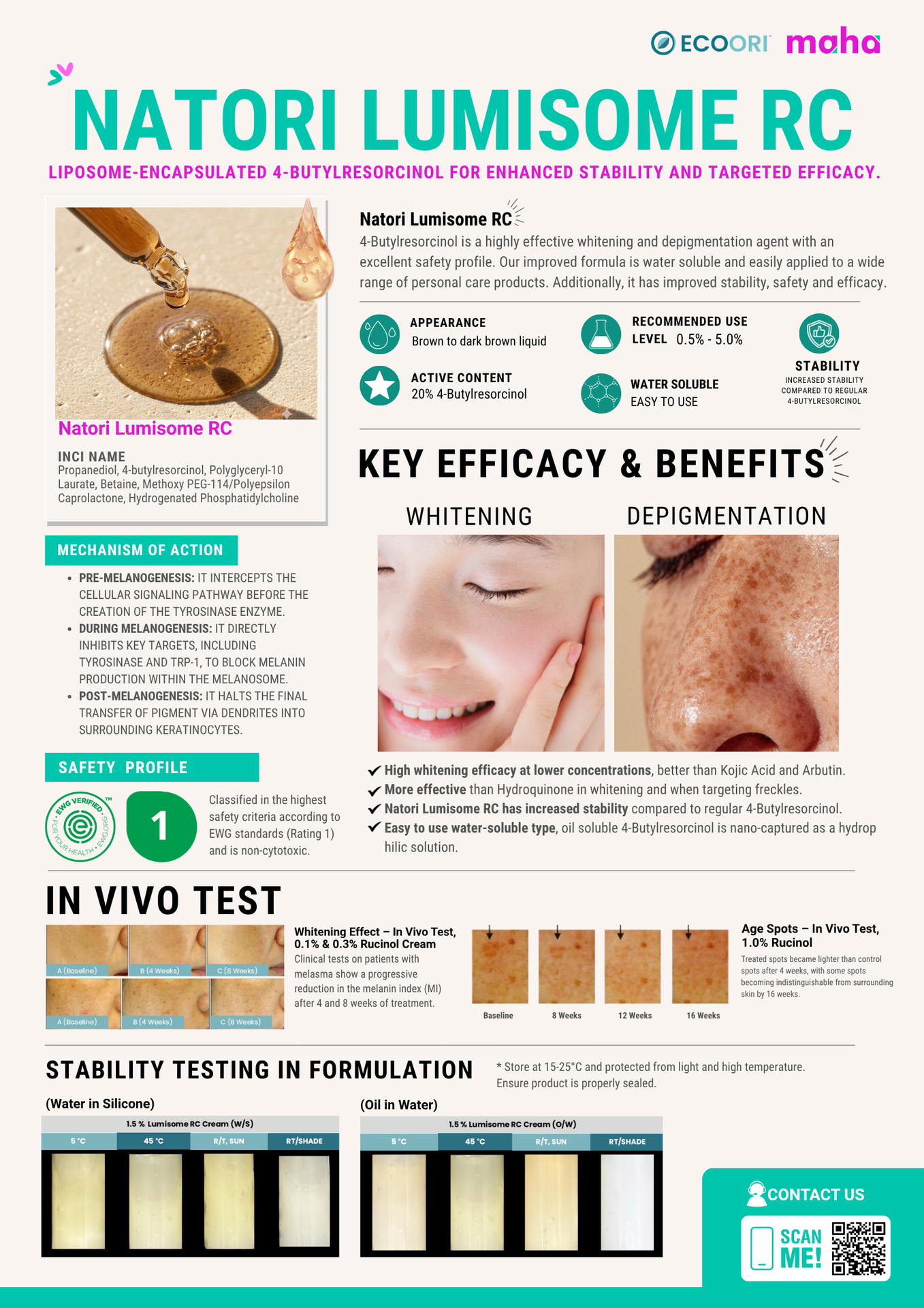
The Active: Natori Lumisome RC
Natori Lumisome RC delivers 20% 4-Butylresorcinol (commonly known as Rucinol) encapsulated in a liposomal delivery system. It's a brown-to-dark-brown liquid, easily water-soluble, with a recommended use level of 0.5–5.0% and a formulation-friendly pH range of 4.0–6.0.
4-Butylresorcinol itself isn't a new molecule — it's been formulated into brightening launches from established global brands for years — but the liposomal encapsulation in Lumisome RC is built to improve delivery efficiency of the active into the epidermis, which is the detail that tends to separate a brightening serum that performs on paper from one that performs on skin.
How It Works: Interrupting Pigmentation at Three Points
Most tyrosinase inhibitors act at a single point in the melanogenesis pathway. 4-Butylresorcinol's mechanism is documented at three:
Pre-melanogenesis — it interferes with the cell-signaling cascade before tyrosinase enzyme synthesis is even triggered at the DNA/mRNA level.
During melanogenesis — it directly inhibits tyrosinase and TRP-1, the two enzymes driving the conversion of tyrosine through DOPA and DOPA quinone into eumelanin and pheomelanin inside the melanosome.
Post-melanogenesis — it disrupts the transfer of already-formed pigment from melanocyte dendrites into surrounding keratinocytes, limiting how much of the pigment that does form actually becomes visible in the skin.
Interrupting the pathway at three separate points, rather than one, is the mechanistic argument for why this active can outperform single-point inhibitors like kojic acid or arbutin at comparable use levels.
Clinical and In Vitro Data
Worth noting: both kojic acid and arbutin have well-established, genuine brightening efficacy in real-world use — the in-vitro comparisons below are one specific lens (relative tyrosinase-inhibiting potency), not a verdict on whether they "work."
Tyrosinase inhibition (in vitro): 4-Butylresorcinol posted an IC50 of 21 µmol/L — meaning it takes a far smaller concentration to meaningfully inhibit tyrosinase activity than the alternatives typically benchmarked against it. Kojic acid's IC50 was 500 µmol/L (over 20x less potent), arbutin's was roughly 6,500 µmol/L, and hydroquinone's was roughly 4,400 µmol/L (JEADV 2013, 27(Suppl.1), 19–23).
Melanin synthesis inhibition (MelanoDerm skin model, 13-day culture): 4-Butylresorcinol achieved the lowest IC50 of the actives tested, at 13.5 µmol/L, edging out hydroquinone (<40 µmol/L) at concentrations above 20 µmol/L. Kojic acid and arbutin trailed well behind, at >400 and >5,000 µmol/L respectively (same source).
Melasma, split-face RCT (0.1% Rucinol cream): across two patients tracked over 8 weeks, melanin index dropped by 11.0 and 26.0 points respectively from baseline (Ann Dermatol Vol.22 No.1, 2010).
Melasma, multicentric study (0.3% Rucinol cream, n=52): mMASI scores fell from a baseline of 13.4–14.9 to 10.8–11.1 at 4 weeks (P=0.009) and 6.4–6.8 at 8 weeks (P<0.001), with no meaningful difference in response across age or sex (Clinical, Cosmetic and Investigational Dermatology 2016:9).
Age spots (1.0% Rucinol, n=15, 53–70 years): treated areas were visibly lighter than vehicle-treated control by week 4, with some spots indistinguishable from surrounding skin by week 16 — and the lightening held for at least 4 weeks after treatment stopped (JEADV 2013).
Speed of visible improvement vs. other resorcinol-family actives: in a head-to-head against 0.3% hexylresorcinol and 0.5% phenylethylresorcinol (n=14, 55–69 years), 4-Butylresorcinol reached statistically significant age-spot lightening within 8 weeks, while the other two actives didn't reach significance until week 12 (same source).
Safety: 4-Butylresorcinol carries an EWG Skin Deep rating of 1 (the best score on their scale), and the 8-week, 52-person clinical run above reported no drug-related adverse events, with high overall tolerability. That said, a separate literature review (J Cosmet Dermatol 2022) notes that other published trials have recorded mild irritation, erythema, or dryness in a subset of users — so the honest positioning is "strong safety profile with the possibility of mild, localized reactions," not "zero risk," which is consistent with any active at this level of potency.
Where It Fits
Lumisome RC is built for serums, essences, and targeted spot-correction formats where the brief calls for a clinically substantiated brightening or dark-spot claim — the kind of claim that increasingly has to survive scrutiny from both regulators and ingredient-literate consumers. At 0.5–5.0% recommended use, it slots into a formulation the way any liposomal active would, without unusual stability or compatibility demands.
Want the Full Data Package?
If you're evaluating actives for an upcoming brightening launch and want the complete clinical dossier, formulation guidance, or a sample of Natori Lumisome RC, reach out to the MAHA team below — we're happy to walk through the data in more depth.