Across Southeast Asia — from Korea to Vietnam, Thailand, Indonesia, and the Philippines — formulators share one common climate reality: heat and humidity keep sebum production elevated and skin feeling oily for longer between cleanses. Formulating for that reality is harder than it looks. A cleanser aimed at oily, acne-prone skin has to satisfy three conditions in the same system at once: a mildly acidic pH, effective sebum removal, and a surfactant base mild enough for daily, high-frequency use. Few single actives are built to carry all three at the same time.
Two things set Supersurf SLA 30G apart from other amino acid surfactants:
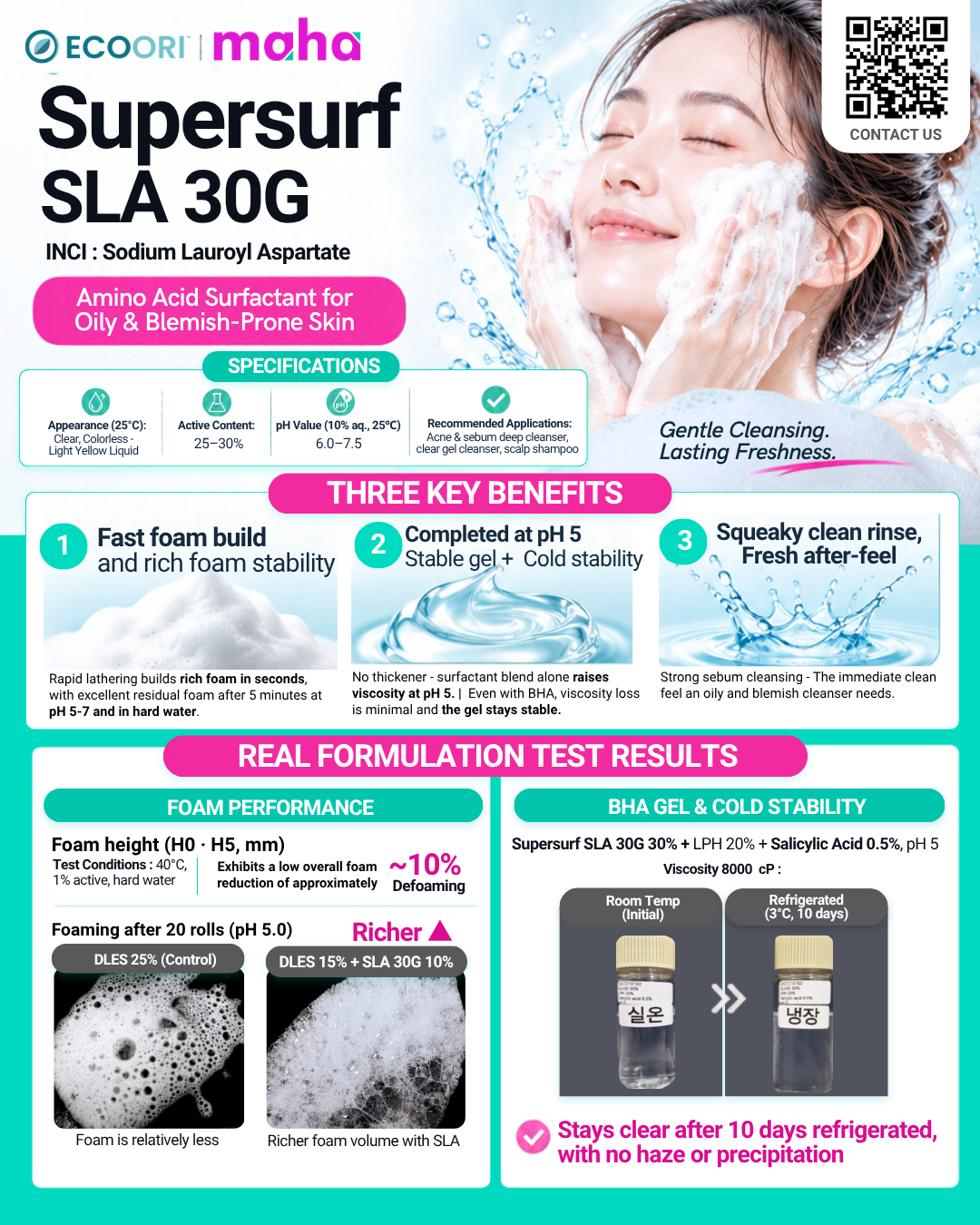
- Faster, richer, more stable foam. It builds in seconds and holds its volume far longer than a DLES-only system — see the Ross-Miles and 20-roll foam test data below.
- A squeaky-clean, fresh after-feel. It rinses cleanly away, without the residual slip typical of other amino acid surfactants like SLG.
Where the Current Mild Surfactant Landscape Falls Short
Look across the established mild liquid surfactants typically reached for in this space, and each one tends to specialize in one or two of these three requirements rather than all of them together:
- Sodium Lauroyl Glutamate (SLG) — excellent mildness, but can leave a slippery after-feel
- Sodium Cocoyl Glycinate (SCG) — strong foam, but typically needs a higher pH (8–10) to perform
- Sodium Cocoyl Isethionate (SCI) — cost-efficient, but limited in liquid formulation flexibility
- Sodium Methyl Cocoyl Taurate (SMCT) — stable at low pH, but difficult to thicken
That is the gap Supersurf SLA 30G is positioned to close for oily and acne-prone skin lines.
Introducing Supersurf SLA 30G
Supersurf SLA 30G (INCI: Sodium Lauroyl Aspartate) is an amino acid-derived anionic surfactant synthesized from L-aspartic acid and lauroyl chloride. It is designed around exactly the three conditions above: quick, stable foam at a mildly acidic pH, a self-thickening gel system at pH 5 that stays compatible with BHA, and a cleansing profile suited to deep, sebum-focused formats.
| INCI Name | Sodium Lauroyl Aspartate |
| CAS No. | 41489-18-3 |
| Active Content | 25.0 – 30.0% |
| pH (10% aq., 25°C) | 6.0 – 7.5 |
| Appearance (25°C) | Clear, colorless to light yellow liquid |
| Recommended applications | Acne & sebum-focused deep cleansers, premium clear gel cleansers, scalp shampoo |
Why It Works: A More Compact Polar Head
The behavioral difference traces back to molecular structure. Compared with glutamate-based surfactants like SLG, the aspartate head group in SLA 30G carries one fewer methylene (CH₂) unit — a more compact head with lower electrostatic repulsion. Published research on pH-dependent N-acylglutamate/aspartate surfactants (Wang et al., 2022, Colloids and Surfaces A) and on the cleansing mechanisms of amino acid surfactants (Bivash et al., 2025, Molecules) points to this compact head structure as a structural reason why aspartate-based surfactants can achieve more efficient interfacial adsorption than their glutamate counterparts across a range of pH.
In practice, that translates into a straightforward three-step cleansing action:
- Contact — the low-viscosity liquid spreads evenly across the sebum layer on skin
- Interfacial penetration — the compact polar head adsorbs efficiently at the sebum–water interface, reducing interfacial tension
- Emulsification & dispersion — sebum breaks into fine emulsion droplets that rinse cleanly away with water
The same surfactant system also does something unusual at pH 5: it self-thickens. Above pH 5.5, SLA 30G behaves as a light, quick-foaming liquid, well suited to auto-foam and liquid cleanser formats. Around pH 5.0, the surfactant blend alone — with no added thickener — crosses a viscosity threshold into a stable gel texture. Formulators can then add salicylic acid (BHA) into that same pH 5 gel system while keeping the texture stable, opening a formulation route to acne-care gel cleansers that would otherwise need a separate thickening system.
What the Data Shows
Foam. In Ross-Miles foam meter testing (40°C, 1% active, hard water, pH 5–10), SLA 30G showed an overall foam decay of only around 10% between initial foam height (H0) and foam height after 5 minutes (H5) — indicating foam that is both quick to form and slow to collapse (source: Ecoori SLMA brochure). In side-by-side testing against a DLES-only control, replacing part of the DLES with SLA 30G (DLES 15% + SLA 30G 10% vs. DLES 25% alone) produced a visibly larger foam volume after 20 rolling cycles at pH 5.0, and better foam retention over time after 10 pumps — the control showed noticeably reduced foam after a short interval, while the SLA 30G-added formula held its foam volume for longer.
Viscosity and cold stability. A surfactant-only blend of SLA 30G 25% + Lauramidopropyl Hydroxysultaine (LPH) 15% reached roughly 5,000 cP at pH 5 with no added thickener, and stayed visually clear across pH 5–7 after 10 days of refrigerated storage at 3°C. Adding salicylic acid to a higher-SLA formulation (SLA 30G 30% + LPH 20% + Salicylic Acid 0.5%, pH 5) reached roughly 8,000 cP and likewise showed no clouding or precipitation after 10 days at 3°C — supporting BHA-containing gel formulations without a separate cold-stability trade-off.
Four Formulation Starting Points
SLA 30G performs across a pH 4–5 working range, with four reference formulations illustrating where it fits:
| Type | Format | SLA 30G | Key partners | Target pH |
|---|---|---|---|---|
| 01 — Quick-foaming | Mass, liquid mild acid cleanser | 20.0% | SMCT 5.0%, SCI 2.0%, humectants 3–5% | 3.8–4.2 |
| 02 — Clear gel | Premium, squeaky-clean transparent gel | 25.0% | LPH 15.0% | 4.9–5.3 (5,000 cP) |
| 03 — BHA-stable gel | Salicylic acid transparent gel | 30.0% | LPH 20.0%, Salicylic Acid 0.5% | 5.0 (8,000 cP) |
| 04 — Value / essential | Mass-market cleanser, DLES boosted | 10.0% | LPH 20.0%, DLES 15.0% | 5.0 |
Across the sensorial side, raising the SLA 30G ratio relative to cationic/amphoteric co-surfactants (for example, from 15% up to 30% of the surfactant system) shifts the after-feel from a creamy, soft finish toward the squeaky, clean-rinse, fresh after-feel that oily and acne-prone skin formats typically aim for. Main recommended categories are body wash, oily-skin cleansers, and acne-prone skin lines in combination with BHA.
Ready to Formulate?
If you are developing a cleanser for oily, acne-prone, or scalp-care lines, Supersurf SLA 30G is available for technical consultation and sampling through MAHA, the official Asia distributor for Ecoori's Supersurf surfactant range.

