Everyone is buying Exosome, PDRN, and NAD+ at the top. The brands that win the next cycle are already accumulating the undervalued upcycled actives that have the fundamentals to go mainstream in 2-3 years.
The trend: ingredient selection is portfolio management
Quick context, because this analogy is everywhere in Korea right now: the share prices of Samsung Electronics and SK Hynix have been the country's biggest financial story of the year, riding the global AI and memory boom to record highs. It is front-page news and dinner-table conversation. So let's borrow the language of that rally and apply it to ingredients.
Look at any 2026 launch and you will see the same blue chips on the INCI list. PDRN is the Samsung Electronics of skincare, the one everyone holds. Exosomes are the SK Hynix, the once-specialist name now surging on the regeneration boom. And NAD+ is the NVIDIA, the momentum stock everyone piled into this year.
There is nothing wrong with blue chips. But a portfolio that is only blue chips has no upside left to capture. The brands that will own the next cycle are scouting undervalued names with strong fundamentals: ingredients that are under the radar today but have the clinical data and the macro tailwind of sustainability, upcycling and regulation to become mainstream in two to three years.
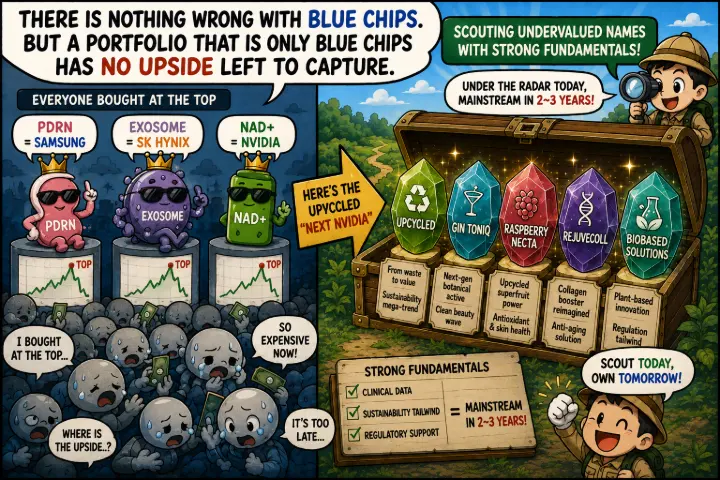
Here are three of those next-NVIDIA candidates from the MAHA upcycled portfolio. Each one already beats a famous incumbent on its own data.
Gin TONIQ: the humectant that out-hydrates hyaluronic acid
Upcycled from brewers' barley and gin-distillery ferment, Gin TONIQ is a fermented humectant. In in-vivo testing with 20 subjects at 5%, it locked in 3x more moisture than glycerine, delivered up to 8-hour hydration, and outperformed sodium hyaluronate at 2, 4 and 8 hours, with a reduction in IL-8 of more than 10%. The default for hydration finally has a challenger, and it is upcycled. COSMOS approved.
Raspberry NECTA: the antioxidant that beats the benchmark
Cold-pressed from raspberry seeds rescued from the juicing industry (about 100,000 raspberries per kg of oil), Raspberry NECTA delivers an ORAC antioxidant capacity 120% higher than standard raspberry oil and 61% higher than standard blueberry oil, with around 20% more tocopherols. A vitamin-E-rich oil that benchmarks above the famous berry oils. COSMOS approved and Upcycled Certified.
Rejuvecoll: the regenerative peptide that rivals PDRN
Upcycled from eggshell membrane, a food-industry by-product, Rejuvecoll is a complete regenerative matrix of collagen, elastin and hyaluronic acid peptides plus more than 400 biomolecules. In a 60-subject clinical study at 2.5%, it improved elasticity by 68% versus control, reduced TEWL by 23%, and cut wrinkle depth by 9.4% at 56 days, with procollagen up 39% in vitro. PDRN-class regeneration from a circular, upcycled source. Vegetarian-friendly, not vegan.
How to rebalance your formulation portfolio
Keep your blue chips. But add a growth sleeve, diversified across three different jobs: Gin TONIQ to challenge your HA hydration line, Raspberry NECTA to upgrade your antioxidant claim above benchmark, and Rejuvecoll to enter clinic-grade regeneration without paying the PDRN premium. Undervalued today, mainstream tomorrow.
Talk to MAHA
Want technical data sheets, formulation guides, or samples for any of these three actives? Talk to the MAHA team at sales@maha.asia.
All efficacy figures are sourced from supplier technical documents on file. The stock-market comparison is an editorial analogy, not investment advice. Adapt all claims to your market's local regulatory framework before use.